
Press Brake Machine Supplier: 20 T to 400 T Models
Hydraulic, NC/PLC and CNC press brake machines built in Ahmedabad, with published specifications for every standard model and custom lengths on request.
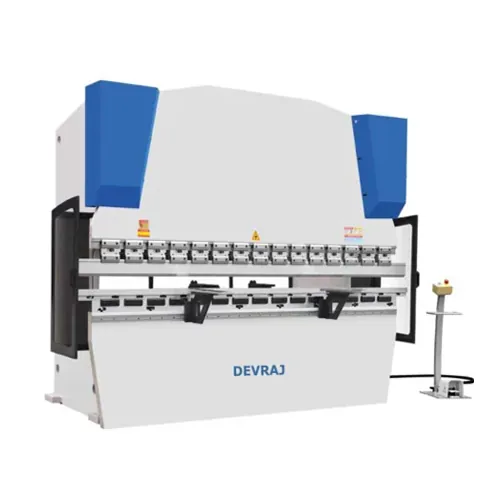
Press brake machines from Devraj Engineering
A press brake machine bends flat sheet and plate into angles, channels, boxes and profiles by pressing it between an upper punch and a lower V-die. It is the main forming machine in almost every sheet metal shop, from 1 mm electrical panel doors to thick structural brackets.
Devraj Engineering Company has been building metal-working machinery in Ahmedabad since 1971. Our press brake range covers compact 20 T hydraulic machines for workshops through to 400 T heavy-duty CNC press brakes for large fabrication plants. As a direct press brake machine supplier and manufacturer, we size each machine to the material, thickness and bending length you actually work with, so you do not pay for tonnage you will never use.
Press brake machine models and specifications
The table lists our standard press brake models. Use it to shortlist by force and working length, then send us your part details for confirmation.
| Model | Nominal force | Working length (mm) | Stroke (mm) | Open height (mm) | Throat depth (mm) | Typical use |
|---|---|---|---|---|---|---|
| Mini CNC Press Brake | 25-40 T | 1600-2000 | On request | On request | On request | Compact machine for light fabrication jobs |
| Hydraulic PBR 215 | 20 T | 1500 | 100 | 250 | 100 | Small industrial bending capacity |
| Hydraulic PBR 320 | 30 T | 2000 | 100 | 250 | 200 | Medium fabrication usage |
| Hydraulic PBR 420 | 40 T | 2000 | 100 | 250 | 200 | Higher thickness bending |
| CNC Press Brake 40T | 400 kN (~40 T) | 1600 | 150 | 430 | 260 | Entry-level CNC production machine |
| CNC Press Brake 80T | 800 kN (~80 T) | 2500 | 160 | 450 | 320 | Common size for sheet metal shops |
| CNC Press Brake 125T | 1250 kN (~125 T) | 3200-4000 | 200 | 480 | 400 | Heavy industrial use |
| CNC Press Brake 250T | 2500 kN (~250 T) | 3200-4000 | 250 | 540 | 450 | Thick plate forming |
| Heavy Duty CNC 400T | 4000 kN (~400 T) | 4000-6000 | 300 | 610 | 500 | Large fabrication plants |
Specifications above are Devraj's published standard models. Working length, stroke, open height, throat depth, control system and tooling can be changed to suit your parts. Final figures are confirmed in the quotation and the machine's test certificate.
Types of press brake machine we supply
Hydraulic press brake
PBR 215, 320 and 420: 20-40 T, 1500-2000 mm. Simple, robust machines for workshops.NC / PLC press brake
Programmable stroke and back gauge at a lower cost than full CNC.CNC press brake
Mini CNC and 40-250 T CNC models for repeatable multi-bend production.Heavy duty press brake
125, 250 and 400 T, up to 6000 mm, for plate and long components.How a press brake works
The sheet is placed on the lower die and pushed against the back gauge, which sets the flange length. The ram carrying the upper punch then comes down. In air bending, the most common method, the punch pushes the sheet into the V-opening without touching the bottom, and the bend angle depends on how deep the punch goes. In bottoming and coining, the sheet is pressed fully into the die, which needs much more force but gives a tighter radius.
On a hydraulic press brake, two hydraulic cylinders, one at each end of the ram, provide the force. The control system decides how far the ram travels and how the back gauge moves between bends. That is the main difference between a basic hydraulic machine, an NC/PLC machine and a CNC press brake.
Features of Devraj press brakes
- Inch, single and continuous cycles so the operator can choose the mode that suits set-up, trial bends or batch production.
- Full powered stroke, making the machine suitable for general sheet metal press work and not only air bending.
- Three ram speeds that reduce idle travel time and improve output per shift.
- Instant ram stoppage, which helps prevent accidents and rejected parts.
- Quiet operation with low impact loads on tools and foundations.
- Lower power consumption and low wear and maintenance, which keep running costs and downtime down.
Materials and parts you can bend
Our press brakes bend mild steel, stainless steel, aluminium, brass and copper. Stainless steel needs roughly 1.5 times the force of mild steel for the same thickness, and soft aluminium about half. Typical parts include:
- Electrical panel doors, enclosures and cable trays
- HVAC duct flanges, plenums and AHU panels
- Lift cabin panels, door frames and car walls
- Commercial kitchen tables, sinks and hoods in stainless steel
- Steel furniture, racks, lockers and shelving
- Automotive brackets, body parts and trailer components
- Structural cleats, purlins and base plates
See press brake applications and the industries we serve for more detail.
Using a press brake as a manufacturer
For a manufacturer, the press brake decides how fast parts move from cutting to welding or assembly. When choosing a press brake machine for manufacturing, look at three numbers together:
- Tonnage: the force needed for your thickest, longest bend, plus a 20% margin. Our tonnage calculator gives a quick estimate.
- Working length: longer than your longest part, with room to bend two short parts side by side if needed.
- Control: a basic hydraulic machine suits mixed job work; NC/PLC suits repeat parts; CNC suits multi-bend parts in volume.
Our guide on how to choose a press brake machine covers this step by step, and the press brake machine price guide explains what drives cost.
Related sheet metal machines
Most shops cut blanks before bending them. Our hydraulic shearing machines (DHSM series) cut mild steel up to 25 mm. For simpler bending of thinner sheet, see the sheet metal bending machine (SBM series). For plate rolling and plate bending rolls, visit our main website platebending.in.
Frequently asked questions
What are the types of press brake machines?
By drive, press brakes are mechanical, hydraulic, pneumatic or electric (servo). By control, they are manual or conventional, NC/PLC and CNC. Devraj Engineering supplies hydraulic press brakes with conventional, NC/PLC or CNC control.
What capacity press brake machines does Devraj make?
Standard models run from 20 T (PBR 215, 1500 mm) to 400 T (Heavy Duty CNC, 4000-6000 mm). Other lengths and tonnages can be quoted on request.
What materials can be bent on a press brake?
Mild steel, stainless steel, aluminium, brass and copper. The required tonnage changes with the material's tensile strength, so tell us the grade when you ask for a quote.
How do I choose the right press brake?
Start from your thickest material, longest bend and the number of bends per part. These fix the tonnage, working length and control system. Our engineers can do this sizing for you from a drawing.
How should a press brake be maintained?
Keep the hydraulic oil clean and at the correct level, lubricate guides and back gauge screws, keep tooling clean and check the hydraulic seals and filters at the intervals in the machine manual. See our maintenance guide.