
Hydraulic Press Brake Machine Manufacturer in India
PBR series hydraulic press brakes from 20 to 40 tonnes for panel makers, HVAC units, furniture makers and job shops.
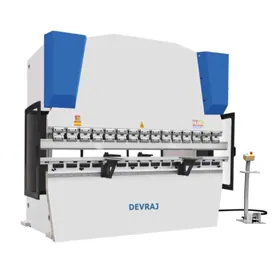
Hydraulic press brake machine for workshops and fabricators
A hydraulic press brake machine uses oil pressure in two cylinders to drive the ram. Compared with older mechanical (flywheel) press brakes, the hydraulic drive gives full force at any point of the stroke, lets the operator stop the ram instantly, and protects the machine from overload through a relief valve. That makes it the most common press brake type in Indian fabrication shops.
Devraj Engineering's PBR series covers the 20 to 40 tonne range. These machines are built for workshops, panel makers and job shops that bend thin to medium sheet every day and want a machine that is simple to run and maintain. As hydraulic press brake machine manufacturers in India since 1971, we build these machines at our Ahmedabad works and supply them across the country.
PBR hydraulic press brake specifications
| Model | Nominal force | Working length (mm) | Stroke (mm) | Open height (mm) | Throat depth (mm) | Typical use |
|---|---|---|---|---|---|---|
| Hydraulic PBR 215 | 20 T | 1500 | 100 | 250 | 100 | Small industrial bending capacity |
| Hydraulic PBR 320 | 30 T | 2000 | 100 | 250 | 200 | Medium fabrication usage |
| Hydraulic PBR 420 | 40 T | 2000 | 100 | 250 | 200 | Higher thickness bending |
Need more force or length? The CNC press brake range starts at 40 T / 1600 mm and goes up to 250 T, and heavy duty models go to 400 T. Hydraulic machines with PLC or NC control are described on the PLC press brake page.
Specifications above are Devraj's published standard models. Working length, stroke, open height, throat depth, control system and tooling can be changed to suit your parts. Final figures are confirmed in the quotation and the machine's test certificate.
How the hydraulic press brake works
- Positioning. The operator places the sheet on the lower die and against the back gauge stops.
- Approach. On pressing the foot pedal, the ram moves down quickly until the punch is just above the sheet.
- Pressing. The ram slows to pressing speed and the hydraulic cylinders push the punch into the sheet to form the bend.
- Return. At the set depth, the ram reverses and returns to the top, ready for the next bend.
The inch, single and continuous cycle modes let the operator inch the ram for set-up, run one stroke per pedal press for normal work, or run continuously for simple repetitive jobs.
Key features
- Inch, single and continuous cycles so the operator can choose the mode that suits set-up, trial bends or batch production.
- Full powered stroke, making the machine suitable for general sheet metal press work and not only air bending.
- Three ram speeds that reduce idle travel time and improve output per shift.
- Instant ram stoppage, which helps prevent accidents and rejected parts.
- Quiet operation with low impact loads on tools and foundations.
- Lower power consumption and low wear and maintenance, which keep running costs and downtime down.
What you can bend on a 20-40 T hydraulic press brake
As a rule of thumb for air bending mild steel with a V-die eight times the thickness, a 1 mm sheet needs about 8 T per metre, 2 mm needs about 16 T per metre and 3 mm needs about 24 T per metre. So:
- A PBR 215 (20 T, 1500 mm) suits light-gauge work such as 1-1.5 mm panels and brackets.
- A PBR 320 (30 T, 2000 mm) handles 2 mm mild steel over most of its length.
- A PBR 420 (40 T, 2000 mm) is the choice when you bend 2 mm over the full length or shorter 3 mm parts.
These are estimates. Stainless steel needs about 50% more force. Use the tonnage calculator for your own figures, or ask us to check your part.
Who buys our hydraulic press brakes
Electrical panel makers
Doors, covers, mounting plates and enclosure bodies in CRCA.HVAC and ducting units
Duct flanges, dampers and AHU panels in GI sheet.Steel furniture makers
Lockers, racks, shelves and office furniture.Job shops
Mixed small-batch work where quick set-up matters more than automation.Buying considerations
- Thickest and longest bend: decides tonnage and working length.
- Throat depth: the PBR 215 has 100 mm, the PBR 320 and 420 have 200 mm. A deeper throat is needed for wide flanges and box-type parts.
- Open height and stroke: deep boxes and tall tooling need more daylight.
- Tooling: standard punch and V-die sets cover most work; gooseneck punches and multi-V dies add flexibility.
- Back gauge: manual or motorised. Ask us which suits your batch sizes.
Frequently asked questions
What is the difference between a hydraulic and a mechanical press brake?
A mechanical press brake stores energy in a flywheel and delivers a fixed stroke. A hydraulic press brake uses cylinders, so force is available throughout the stroke, the ram can stop instantly, and overload is limited by a relief valve. Hydraulic machines are safer and more flexible for general fabrication.
What is the smallest hydraulic press brake you make?
The PBR 215: 20 T force, 1500 mm working length, 100 mm stroke, 250 mm open height and 100 mm throat depth.
Can a hydraulic press brake be upgraded with NC or CNC control?
Control options are best chosen when the machine is ordered, because the hydraulic and electrical systems are designed around them. Tell us if you expect to need programmable control later and we will advise.
Is foundation work required?
Smaller press brakes usually stand on a level, reinforced shop floor. Larger machines need a foundation. We share the foundation and floor requirements with the quotation.